Did you know that the Aldabra giant tortoise (at 4.5 metres per minute) is the most sluggish of all tortoises and that its poo provides a culinary feast for hermit crabs? What about the star-nosed mole, who can eat five times its body weight in a day, making it the world’s fastest eater? Or the dwarf seahorse, which is the slowest moving fish in the world?
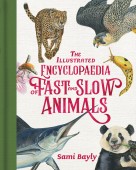
Even if you do know about these record-taking fast and slow animals, there are 57 more you can find out about in Sami Bayly’s new book The Illustrated Encyclopaedia of Fast and Slow Animals.
Iconic animals known for speed, like the black marlin, cheetah and hare are included, as are well-known slow movers like the garden snail and the sloth. But Bayly also features animals that aren’t just the fastest and slowest walkers, runners and fliers – for instance the slow-ageing Greenland shark (also known as the sleeper shark), the high-speed spitting banded archerfish (its special eyes help aim its spit at prey) and the fast-clawed pistol shrimp (whose claws snap shut at 100 kilometres an hour).
As Bayly says in the encyclopaedia’s introduction, size to speed ratio is also important. Certain mites, for example, are among the fastest creatures on earth due to their ability to move a certain amount of body lengths over time in relation to their size. If a human ran 322 body lengths per second like a Californian mite does, she notes, they would cover 2317 kilometres per hour!
Two of my fast-favourite creatures Bayly includes are the Moroccan flic-flac spider (which performs gymnastic leaps down dunes at 2 metres per second to escape predators) and the peregrine falcon (the fastest animal on the planet, which can swoop at 83 metres per second).
Two of my slow-burn beauties are the Pacific banana slug (very slow and coloured like a banana) and the Olm (one Olm observed was so slow moving it didn’t move at all in seven years).
For each of the 60 creatures included there is a double page spread, one page for the illustration and scientific name and the other page for information about the animal’s fast or slow feats, conservation status, location/habitat and diet. There is also a box containing fun facts.
One intriguing illustration is of the ox heart ascidian, also known as the gold-mouth or ink-spot sea squirt, whose squishiness is well-rendered by Bayly in vivid purple and orange. I also liked her haunting depiction of the great barracuda, whose big eyes and teeth are accentuated through forced perspective and a brooding sea layered from indigo to tropical turquoise.
The Australian lungfish and the Australian tiger beetle were two Aussie animals I was happy to learn more about. The lungfish has been around for 380 million years, and the tiger beetle is the fastest-running insect on the planet; speed needed to propel it across the burning sands of our dry salt lakes and arid deserts.
I know an 8- and a 10-year-old boy who will love to receive this encyclopaedia for Christmas and I’m pretty sure their parents will find it fascinating too. I’ll get a gold star for choosing a beautiful and educational gift that will engross both fast and slow humans for hours.
The Illustrated Encyclopaedia of Fast and Slow Animals
Sami Bayly
Hachette HB $32.99
Imprint: Lothian Children’s Books


Recent Comments